
How Does Dual Channel ABS Work in Bikes? A Complete Guide for Every Rider
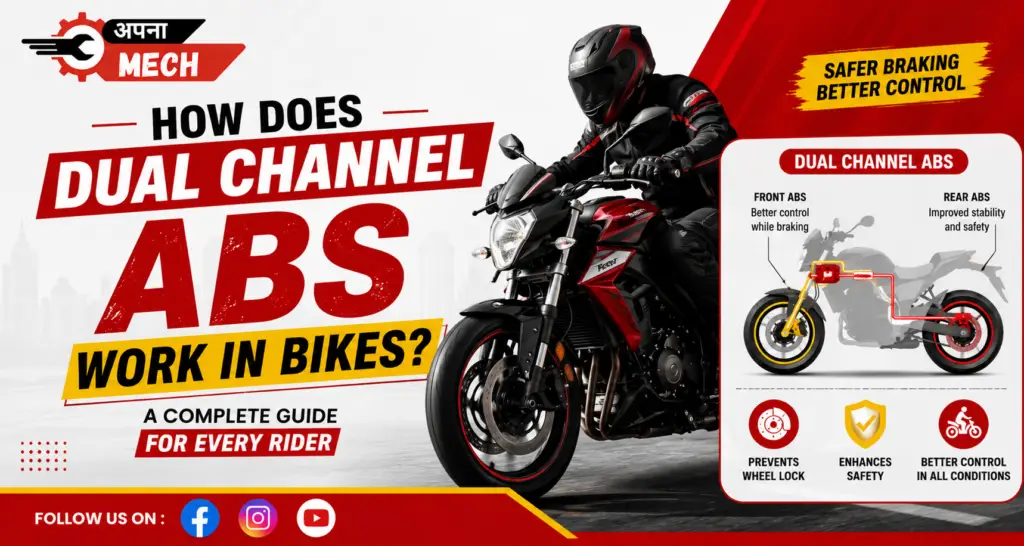
Braking is one of the most important aspects of motorcycle safety. Whether you’re riding through busy city streets or cruising on the highway, sudden obstacles can appear without warning. During emergency braking, locking either wheel can cause the motorcycle to skid, reducing your control and increasing the risk of an accident.
This is where Dual Channel ABS (Anti-lock Braking System) plays a vital role. It helps riders maintain control while braking hard by preventing both wheels from locking.
At Apna Mech, we believe every rider should understand how modern safety technologies work. In this guide, we’ll explain what Dual Channel ABS is, how it works, its benefits, and whether it’s worth choosing for your next motorcycle.
What is Dual Channel ABS?
Dual Channel ABS is an advanced braking safety system that independently monitors both the front and rear wheels of a motorcycle.
Unlike a standard braking system, Dual Channel ABS continuously checks the speed of both wheels. If it detects that either wheel is about to lock during hard braking, it automatically adjusts the brake pressure to maintain tyre grip and improve stability.
This technology helps riders stop safely while maintaining steering control, especially during emergency situations.
How Does Dual Channel ABS Work?
The working principle of Dual Channel ABS is based on maintaining tyre traction while braking.
Each wheel is equipped with a speed sensor that constantly monitors wheel rotation. These sensors send real-time data to the motorcycle’s Electronic Control Unit (ECU).
If the ECU detects that either wheel is slowing down too quickly and is about to lock, it immediately signals the hydraulic modulator to reduce brake pressure momentarily. As soon as the wheel regains traction, brake pressure is reapplied. This process happens several times every second.
The rider may notice a slight vibration or pulsing in the brake lever or pedal during hard braking. This is completely normal and indicates that the ABS system is actively preventing wheel lock-up.
Main Components of a Dual Channel ABS System
A Dual Channel ABS system consists of three primary components that work together to improve braking safety.
Wheel Speed Sensors
Sensors mounted on both wheels continuously monitor their rotational speed and send data to the ECU.
Electronic Control Unit (ECU)
The ECU acts as the brain of the ABS system. It processes data from the wheel sensors and determines when brake pressure needs adjustment.
Hydraulic Modulator
The hydraulic modulator automatically increases or decreases brake pressure to each wheel independently, ensuring maximum grip during braking.
Benefits of Dual Channel ABS
Dual Channel ABS offers several advantages that significantly improve motorcycle safety and rider confidence.
One of its biggest benefits is preventing both front and rear wheel lock-up during sudden braking.
It also helps riders maintain steering control while braking, allowing them to avoid obstacles more effectively.
On wet roads, loose gravel, or slippery surfaces, Dual Channel ABS provides better stability by reducing the chances of skidding.
Because both wheels continue rotating instead of locking, braking distances are often shorter on low-traction surfaces.
The system also boosts rider confidence during long-distance touring and everyday commuting by providing an additional layer of safety.
Dual Channel ABS vs Single Channel ABS
Many riders wonder whether Dual Channel ABS is worth choosing over Single Channel ABS.
Single Channel ABS controls only the front wheel, while the rear wheel can still lock during hard braking.
Dual Channel ABS monitors and controls both the front and rear wheels independently, offering greater safety and improved braking performance.
| Feature | Single Channel ABS | Dual Channel ABS |
|---|---|---|
| Wheel Protection | Front Wheel Only | Front & Rear Wheels |
| Rear Wheel Lock Prevention | No | Yes |
| Stability During Braking | Good | Excellent |
| Wet Road Performance | Good | Better |
| Emergency Braking | Moderate | Superior |
| Best For | Daily Commuting | Touring, Highway & Premium Bikes |
Is Dual Channel ABS Worth It?
For most riders, the answer is yes.
If you regularly ride on highways, travel long distances, or encounter wet roads during the monsoon, Dual Channel ABS offers a significant safety advantage.
Even experienced riders can accidentally lock a wheel during panic braking. Since ABS reacts much faster than human reflexes, it helps maintain balance and control when it matters most.
Although motorcycles equipped with Dual Channel ABS may cost slightly more, the additional safety is well worth the investment.
Common Myths About Dual Channel ABS
Many riders still have misconceptions about ABS technology.
One common myth is that ABS increases stopping distance. In reality, on wet or slippery roads, ABS often reduces stopping distance while maintaining steering control.
Another misconception is that skilled riders don’t need ABS. Even professional riders cannot modulate brake pressure as quickly and accurately as an electronic ABS system.
Some people also believe rear-wheel ABS is unnecessary. However, rear-wheel lock-up is one of the most common causes of skidding during emergency braking, making Dual Channel ABS significantly safer than Single Channel ABS.
Tips for Riding a Motorcycle with ABS
To get the best performance from your ABS-equipped motorcycle, always apply firm and consistent brake pressure during emergency stops. Avoid repeatedly pumping the brakes, as the ABS system is designed to do this automatically.
If you feel vibration in the brake lever or pedal during hard braking, don’t panic. It simply means the ABS is working correctly.
Maintain proper tyre pressure and replace worn tyres on time, as even the best braking system cannot compensate for poor tyre condition.
Regular servicing is equally important. Keeping the brake fluid fresh, inspecting wheel sensors, and maintaining the braking system ensures the ABS continues to perform reliably.
Apna Mech’s Recommendation
At Apna Mech, we strongly recommend choosing a motorcycle equipped with Dual Channel ABS if your budget allows. Whether you ride daily in the city, commute on highways, or enjoy weekend tours, ABS significantly improves braking safety and rider confidence.
Our expert mechanics also recommend regular brake inspections, timely brake fluid replacement, brake pad checks, and ABS diagnostics to ensure your braking system performs at its best.
Conclusion
Dual Channel ABS is one of the most important safety technologies available on modern motorcycles. By preventing both wheels from locking during sudden braking, it helps riders maintain stability, steering control, and confidence in emergency situations.
While Single Channel ABS offers basic protection, Dual Channel ABS provides superior braking performance, especially on wet roads, highways, and unpredictable riding conditions.
No matter which motorcycle you ride, maintaining your braking system is essential for safe riding. With professional doorstep servicing and expert brake inspections from Apna Mech, you can keep your motorcycle’s braking system in top condition and enjoy every ride with greater peace of mind.
Frequently Asked Questions
1. What is Dual Channel ABS in bikes?
Dual Channel ABS is an Anti-lock Braking System that monitors both the front and rear wheels independently, preventing either wheel from locking during hard braking.
2. How does Dual Channel ABS work?
Wheel speed sensors send data to the Electronic Control Unit (ECU). If the ECU detects wheel lock-up, the hydraulic modulator automatically adjusts brake pressure several times per second to maintain traction and stability.
3. What is the difference between Single Channel and Dual Channel ABS?
Single Channel ABS controls only the front wheel, whereas Dual Channel ABS independently controls both front and rear wheels, providing better braking performance and improved rider safety.
4. Does Dual Channel ABS reduce stopping distance?
On wet, slippery, or uneven roads, Dual Channel ABS often reduces stopping distance while helping maintain steering control and stability.
5. Does Apna Mech service ABS-equipped motorcycles?
Yes. Apna Mech provides professional doorstep servicing, brake inspections, ABS diagnostics, brake fluid replacement, brake pad replacement, and complete maintenance for motorcycles equipped with both Single Channel and Dual Channel ABS systems.

Add comment