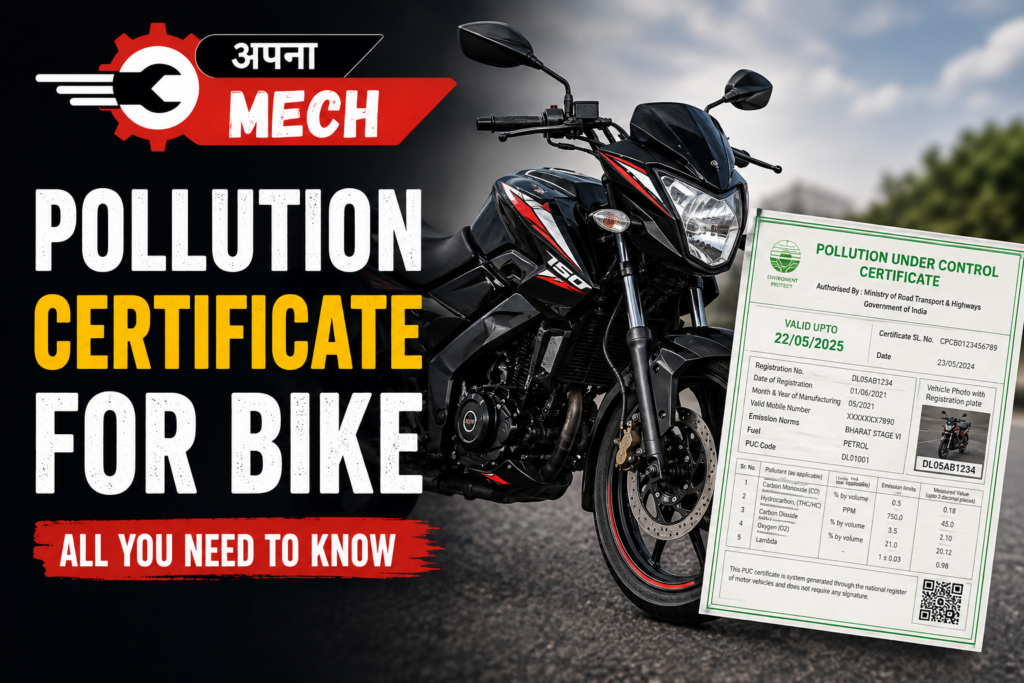
Pollution Certificate for Bike: All You Need to Know
Owning a bike in India comes with several responsibilities, and keeping a valid Pollution Under Control (PUC) Certificate is one of them. A PUC certificate confirms that the emissions produced by your motorcycle or scooter are within the permissible limits prescribed under applicable pollution-control regulations. Whether you ride a commuter bike, scooter, premium motorcycle, sports bike, or another petrol-powered two-wheeler, it is important to understand why a PUC certificate is required, where you can obtain it, how the emission test is conducted, and how you can check your certificate details online.
Regular bike maintenance can also play an important role in keeping emissions under control. Problems with the engine, air filter, spark plug, fuel system or exhaust can affect combustion and may contribute to higher emissions. At Apna Mech, we help two-wheeler owners with regular servicing, inspection and repair so that their bikes remain in better operating condition.
What is a PUC Certificate?
PUC stands for Pollution Under Control. It is a certificate issued after testing a vehicle’s exhaust emissions to determine whether they meet the applicable emission standards. During the test, the authorized testing center measures the emissions produced by the vehicle. If the readings are within the permitted limits, the vehicle is issued a PUC certificate. The certificate generally contains important details related to the vehicle and its emission test, including the registration number, test information, emission readings and validity details.
A valid PUC certificate is an important document for vehicle owners, so riders should keep track of its expiry date and renew it when required.
How Can a Bike Owner Get a PUC Certificate?
Bike and scooter owners can obtain their Pollution Under Control certificate through an authorized emission testing facility. The general process involves taking the motorcycle to an authorized PUC testing center, where the vehicle’s exhaust emissions are measured using approved testing equipment.
You can usually find PUC testing facilities at locations such as:
- Authorized pollution testing centers.
- Licensed standalone emission testing centers.
- Fuel stations equipped with authorized emission testing facilities.
How Do You Get a PUC Certificate Offline?
Getting a PUC certificate from an authorized testing center is generally a straightforward process.
Step 1: Take your bike or scooter to an authorized PUC testing center.
Step 2: Follow the instructions provided by the testing operator and position the motorcycle as required.
Step 3: The operator will use the appropriate emission testing equipment to measure the exhaust gases from your vehicle.
Step 4: The test results are checked against the applicable emission limits.
Step 5: If your vehicle meets the required standards, the operator generates the PUC certificate after completing the necessary process and payment.
The certificate should contain the correct vehicle details, so check the information before leaving the testing center.
Where Can You Get a PUC Certificate?
A PUC certificate should be obtained from an authorized pollution testing facility.
- Fuel stations with PUC testing equipment
- Dedicated emission testing centers
- Other authorized vehicle pollution testing facilities
It is important to make sure that the facility is authorized to conduct emission tests and issue PUC certificates.
How to Check Your PUC Certificate Online?
Vehicle owners can check their PUC certificate details through the official Parivahan/VAHAN system, subject to the services currently available on the portal.
Step 1: Visit the official Parivahan website.
Step 2: Look for the PUC-related service or certificate option.
Step 3: Enter the requested vehicle information, such as the registration number and other verification details.
Step 4: Submit the information to retrieve the available PUC details.
Step 5: Check the certificate information, emission readings and validity details displayed for your vehicle.
Online services can be updated from time to time. Therefore, if you need to obtain or renew a certificate, follow the latest instructions displayed on the official Parivahan portal.
How Is the Bike Emission Test Conducted?
The emission test is performed using specialized equipment at an authorized testing center. The exact procedure can vary depending on the type of vehicle and testing equipment being used.
Step 1: The operator asks the rider to position the motorcycle correctly at the testing location.
Step 2: The appropriate emission-testing equipment is connected to or positioned at the vehicle’s exhaust outlet.
Step 3: The engine is started and operated according to the instructions given by the testing operator.
Step 4: The testing equipment measures the relevant exhaust emission levels.
Step 5: The readings are recorded and checked against the applicable limits.
Step 6: The vehicle’s registration details may also be recorded or verified as part of the certificate-generation process.
If the vehicle passes the applicable emission requirements, the PUC certificate is issued according to the testing system and applicable rules.
What Emissions Are Checked During a Vehicle Pollution Test?
The emissions measured during a PUC test depend on the vehicle’s fuel type, emission standards and applicable testing procedure.
For petrol-powered vehicles, emission testing can involve measurements related to gases such as:
- Carbon Monoxide (CO): CO is produced during fuel combustion. Its level can provide information about combustion conditions and engine operation.
- Hydrocarbons (HC): HC measurements relate to unburnt fuel present in the exhaust gases.
- Carbon Dioxide (CO₂): CO₂ is a normal product of fuel combustion and may be included in emission-related measurements depending on the testing procedure.
For diesel vehicles, testing can involve:
- Smoke opacity or smoke density: This helps measure the level of visible smoke produced by the engine.
- Other applicable emission parameters: These depend on the vehicle type, emission standard and testing procedure.
Vehicles using CNG or LPG can also be subject to applicable emission checks, which may include measurements related to CO and HC and other requirements specified for the vehicle and fuel system.
The exact parameters and permissible limits can change with emission norms and government regulations, so vehicle owners should follow the requirements applicable to their vehicle.
Why Does Regular Bike Servicing Matter for Pollution?
A PUC certificate is obtained through an emission test, but regular maintenance can help keep the motorcycle’s engine and related systems working properly. Issues such as a clogged air filter, poor combustion, worn spark plug, incorrect engine tuning, fuel-system problems or exhaust-related issues can affect how efficiently an engine operates.Regular servicing can help identify such problems early.
- Periodic bike servicing
- Engine inspection and repair
- Air filter replacement
- Spark plug inspection
- Engine oil replacement
- Fuel-system inspection
- Electrical diagnosis
- Exhaust-related inspection
- General bike maintenance
However, passing a service inspection does not replace the official PUC emission test. The PUC certificate must be obtained through an authorized testing facility.
How Long Is a PUC Certificate Valid?
The validity of a PUC certificate depends on the vehicle, its age, applicable emission norms and current government regulations. New vehicles may have a different initial PUC validity period compared with older vehicles. After the initial period, vehicle owners generally need to undergo periodic emission testing and renew the certificate according to the applicable schedule.Because PUC validity rules can change, it is always advisable to check the current validity shown on your certificate or verify the latest requirements through the official Parivahan system.Do not wait until the certificate has expired. Keep a note of the expiry date and arrange the required test in advance.
What Happens If Your Bike Does Not Meet the Emission Standards?
If the emission readings from your motorcycle are above the permitted limits, the vehicle may not qualify for a valid PUC certificate.
In such a situation, it is better to identify the reason behind the high emissions rather than simply continuing to ride the motorcycle without addressing the problem.
- Poor engine tuning
- Dirty or blocked air filter
- Worn spark plug
- Fuel-system problems
- Engine-related issues
- Exhaust-system problems
- Poor combustion
A qualified mechanic can inspect the motorcycle and identify the repairs or maintenance required. Once the issue has been corrected, the vehicle can be taken to an authorized PUC testing center for the applicable emission test again.
Conclusion
A valid Pollution Under Control Certificate is an important requirement for vehicle owners in India. It provides confirmation that the vehicle has been tested for emissions and meets the applicable pollution standards at the time of testing. For bike and scooter owners, keeping track of the PUC validity date is just as important as maintaining insurance, registration and other required vehicle documents. Regular servicing can also help keep your motorcycle’s engine, fuel system, air intake and other components in good working condition. If your bike is showing unusual smoke, poor performance, reduced mileage or other engine-related symptoms, getting it inspected early can help prevent bigger problems.

Add comment