How to Start a Multi Brand Two Wheeler Service Center in India
Running a two-wheeler service center can be a practical business opportunity in India, especially when the workshop is built around multi-brand servicing, reliable repairs and good customer service. India continues to have a very large two-wheeler customer base. In FY 2025–26, domestic two-wheeler sales reached a record 2.17 crore units, according to the Society of Indian Automobile Manufacturers (SIAM). That growing vehicle base also creates ongoing demand for servicing, repairs, tyres, batteries, spare parts and periodic maintenance. But opening a garage is not simply about renting a shop and hiring a mechanic. The location, equipment, staff, service quality, pricing and customer acquisition all have a direct impact on whether the business becomes sustainable.
Why Start a Two-Wheeler Service Center?
A motorcycle or scooter requires maintenance throughout its ownership. Engine oil, brakes, tyres, batteries, chains, filters, clutch components and electrical parts eventually need inspection or replacement. A multi-brand workshop has an additional advantage: you are not dependent on customers of one motorcycle brand. You can serve customers with bikes and scooters from different manufacturers, depending on your technicians’ skills and available equipment.
A professional workshop can offer:
- Periodic bike servicing
- General repairs
- Engine repair
- Brake and clutch work
- Chain and sprocket service
- Battery and electrical work
- Tyre and puncture services
- Washing and detailing
- Spare parts
- Diagnostics
- EV two-wheeler support, where technicians and equipment are available
This creates several revenue opportunities from the same customer base.
What Makes a Multi-Brand Workshop Different?
A single-brand workshop mainly targets customers of one manufacturer. A multi-brand center can accept several brands and models. For a local entrepreneur, this can make the customer pool wider. It also allows the workshop to build relationships with daily commuters, delivery riders, families, students and premium-bike owners in the surrounding area. The multi-brand workshop model is also becoming more relevant as motorcycles and scooters remain an important part of everyday transportation. Industry sources point to strong demand for independent workshops as vehicles require regular maintenance after the warranty period.
How Much Investment Is Required?
There is no single fixed cost for opening a bike service center. The investment depends heavily on the city, shop size, rent, equipment, number of technicians and level of workshop setup.
For a professional small-to-medium multi-brand workshop, a practical starting budget can include:
| Expense | Approximate Range |
|---|---|
| Rent deposit & advance | ₹1–4 lakh |
| Interior & workshop setup | ₹1.5–5 lakh |
| Lifts, ramps & tools | ₹2–8 lakh |
| Diagnostic equipment | ₹1–5 lakh |
| Compressor & pneumatic equipment | ₹25,000–₹60,000 |
| Initial spare-parts stock | ₹1–3 lakh |
| Branding & signage | ₹50,000–₹1.5 lakh |
| Working capital | ₹1–3 lakh |
These are planning estimates, not guaranteed prices. Actual costs vary significantly by location and business model. A current Indian auto-workshop business-plan guide, for example, places major setup categories such as deposits, interiors, lifting equipment and diagnostics within similar broad ranges. If you choose a franchise model, the investment structure can be different because branding, setup support, training, marketing and other components may be included according to the franchise agreement.
Choosing the Right Location
Location can make or break a workshop. You do not necessarily need the most expensive commercial road in the city. In fact, an expensive location can put unnecessary pressure on monthly expenses.
Good two-wheeler movement:
Residential areas, office clusters, markets and delivery hubs can provide regular demand.
Easy access:
Customers should be able to enter and exit the workshop without difficulty.
Parking space:
Even a small waiting or parking area makes the customer experience better.
Visible frontage:
A workshop that can be easily seen from the road has an advantage over a hidden garage.
Nearby residential societies:
Daily commuters living nearby can become repeat customers.
Competition:
Some competition is normal, but avoid locations where several established workshops are already fighting for the same small customer base.
For Tier-1 cities, rent may be significantly higher, so a smaller but efficiently designed workshop can sometimes make more sense. Tier-2 and Tier-3 cities may offer lower operating costs, but the local customer base and spending capacity should be studied before investing.
What Equipment Does a Workshop Need?
A professional service center needs more than a toolbox. Depending on the services you plan to provide, the workshop may require motorcycle lifts or ramps, air compressors, pneumatic tools, battery testers, tyre equipment, diagnostic scanners, electrical tools, oil-drain equipment and safety equipment. For modern fuel-injected motorcycles, diagnostic capability is becoming increasingly useful. Multi-brand diagnostic equipment can help technicians identify electronic faults that cannot always be found through a basic mechanical inspection. The important point is to buy equipment according to your actual service plan rather than spending heavily on machines that will rarely be used.
Hiring the Right Mechanics
Your mechanics are the heart of the business. A customer may forgive a slightly longer waiting time, but repeated repair mistakes can quickly damage a workshop’s reputation.
- Common commuter motorcycles
- Scooters
- Fuel-injection systems
- Electrical diagnostics
- Braking systems
- Clutch and transmission work
- Engine repairs
- Premium motorcycles
- EV systems, where applicable
How Does a Service Center Make Money?
A workshop normally earns from multiple services rather than one large-ticket job. For example, a customer may initially come for a periodic service and later require brake pads, chain-sprocket replacement, battery replacement, tyre work or another repair. This is why customer retention is extremely important. A workshop with 100 regular customers can be more valuable in the long run than a workshop that constantly spends money searching for new customers.
Service labour + spare parts + tyres + batteries + washing + accessories + specialised repairs.
Understanding ROI
ROI should be calculated from your actual numbers, not from a generic franchise advertisement or an online profit calculator.
For example, suppose a workshop eventually reaches:
- 12 jobs per day
- Average billing of ₹1,000
- 26 working days per month
That gives approximately ₹3.12 lakh monthly gross sales.
But gross sales are not profit.
- Rent
- Salaries
- Electricity
- Consumables
- Spare-parts cost
- Marketing
- Taxes
- Software and administration
- Equipment maintenance
- Other operating expenses
A different business-plan example from Bajaj Finserv illustrates the same point: its sample workshop with 12 vehicles per day and ₹2,000 average billing projects ₹7.2 lakh monthly revenue, but the calculation is a revenue projection, not a guaranteed profit figure. So, when calculating ROI, the better question is:
How many bikes can I realistically service every day, what will my average invoice be, and what will my monthly fixed and variable expenses look like?
Starting with an Apna Mech Franchise
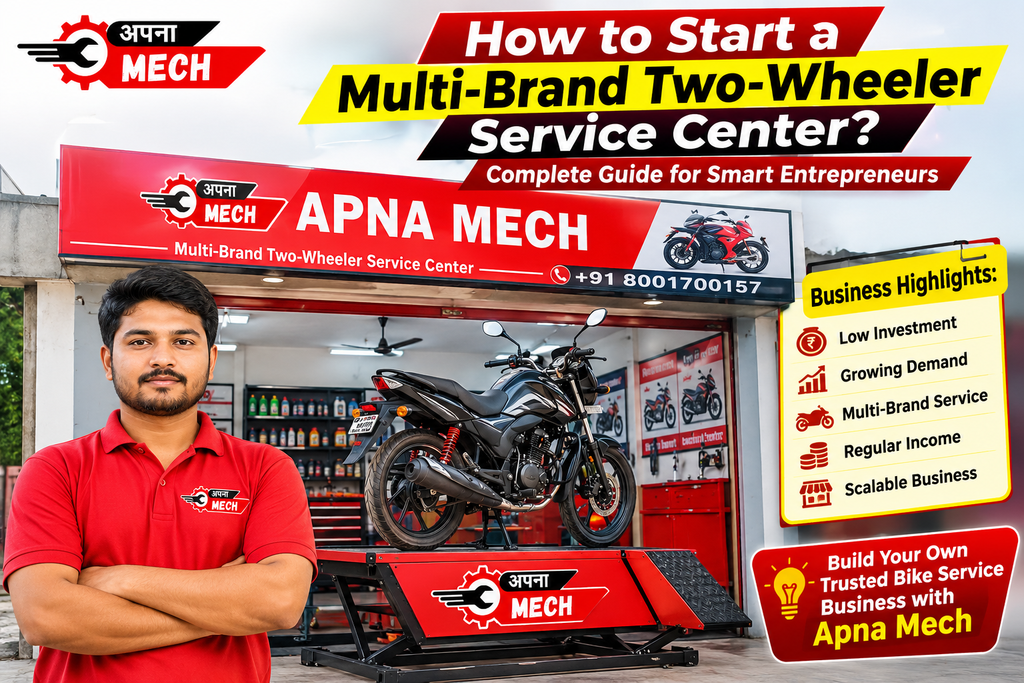
For entrepreneurs who do not want to build everything from scratch, a branded franchise can be another route. Apna Mech currently presents its franchise model as a multi-brand two-wheeler workshop opportunity, with support covering areas such as workshop setup, installation, marketing and spare-parts inventory. The advantage of this approach is that an entrepreneur can work with an established business structure instead of developing the branding, operating process and marketing strategy completely on their own. However, before investing, a franchise buyer should always understand the complete commercial agreement, included services, recurring fees, territory terms, working-capital requirement and expected operating costs.
Who Can Start This Business?
You do not necessarily have to be a mechanic to own a service center. An entrepreneur can manage the business while an experienced technical team handles repairs. At the same time, someone with a mechanical background may have an advantage in understanding repair quality, spare parts and workshop operations. The most important qualities are discipline, customer handling, financial control and consistency.
Final Thoughts
A multi-brand two-wheeler service center can become a strong local business when it is planned properly. India’s two-wheeler market is large, and FY 2025–26 recorded the industry’s highest-ever domestic two-wheeler sales of 2.17 crore units. That means the long-term requirement for maintenance and repair remains substantial. But a workshop does not become profitable simply because there are many bikes on the road. Location, skilled mechanics, correct equipment, transparent pricing, spare-parts availability, customer trust and repeat business are what make the difference. For anyone planning to open a garage, start with the numbers first. Study the local two-wheeler population, competition, rent, customer profile and expected daily workload. Then decide whether an independent workshop or a franchise model makes more sense. Start small if necessary, control your costs, build customer trust and grow the workshop step by step. For franchise and business information, Apna Mech offers a multi-brand two-wheeler workshop model for entrepreneurs looking to build their own service business.

Add comment