How to Get Better Average from Your E20-Compatible Two Wheeler
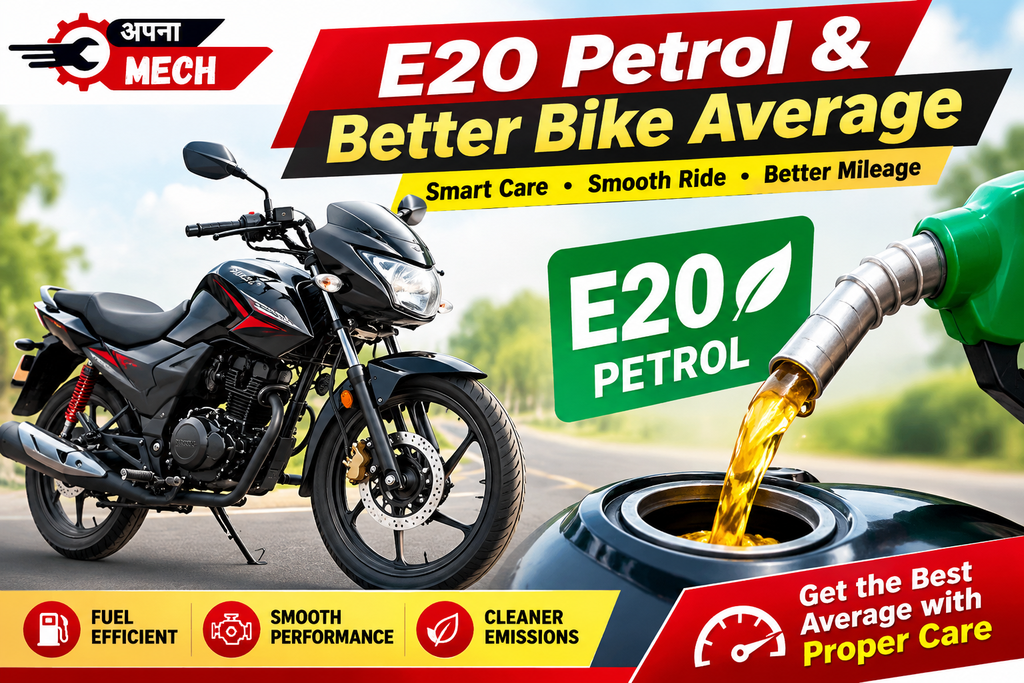
E20 petrol has become a normal part of the fuel conversation for Indian bike and scooter owners. Many riders have one simple question: “My bike is running on E20, but how can I get good mileage?” The answer is not to blame E20 for every drop in mileage. Fuel economy depends on several things—your bike’s engine condition, tyre pressure, chain, air filter, riding habits, traffic and even how regularly the bike is serviced. E20 means petrol containing up to 20% ethanol. India has been gradually increasing ethanol blending, and E20-compatible vehicles are designed and tested for this fuel. ARAI, along with industry and oil companies, has carried out testing covering fuel economy, durability, emissions and material compatibility.
Does E20 reduce bike mileage?
Yes, some reduction in fuel efficiency can occur, particularly in vehicles that were designed around lower ethanol blends. Earlier government and ARAI related studies found a fuel-economy reduction in some E10-compatible two-wheelers when tested with E20. The exact change varies by vehicle, engine calibration and operating conditions. This does not mean that every E20-compatible bike will suddenly give poor mileage. Newer vehicles developed and calibrated for E20 are built with the fuel in mind. So, instead of worrying only about the fuel, it is better to make sure your bike is properly maintained and running efficiently.
How to improve bike mileage with E20 petrol
1. Keep the tyre pressure correct
Tyres with low pressure create more rolling resistance, which makes the engine work harder. This can directly affect mileage. Check tyre pressure regularly and follow the pressure recommended by your motorcycle manufacturer. Do not simply increase or decrease pressure to improve mileage.
2. Keep the chain clean and properly lubricated
A dry, excessively tight or poorly maintained chain creates unnecessary resistance. Clean and lubricate the chain at the recommended intervals. Also check the chain slack and sprocket condition during servicing. A smooth drivetrain helps the engine transfer power more efficiently to the rear wheel.
3. Don’t ignore the air filter
Your engine needs the right amount of clean air for efficient combustion. A heavily clogged air filter can affect performance and fuel economy. If you ride regularly in dusty roads or heavy traffic, the air filter may need attention more frequently than the standard schedule.
4. Use the correct engine oil
Engine oil is not just about lubrication. The correct grade helps the engine operate smoothly and protects internal components. Always use the oil grade and specification recommended by your bike manufacturer. Changing oil too frequently is unnecessary, but stretching service intervals too far can also be harmful.
5. Check spark plug and fuel-system condition
If your bike is giving unusually poor mileage, difficult starting, uneven idling or hesitation, don’t immediately assume E20 is the reason. A worn spark plug, dirty injector, throttle-body deposits or other engine-related issues can affect combustion and mileage. A proper inspection can help identify the actual problem.
6. Avoid aggressive acceleration
One of the easiest ways to improve mileage is also one of the simplest: ride smoothly. Repeated hard acceleration, sudden braking and high-speed riding can increase fuel consumption considerably. Try to maintain a steady speed wherever traffic conditions allow. This does not mean riding unusually slowly. It means avoiding unnecessary throttle changes and keeping your riding smooth.
7. Don’t keep the engine idling unnecessarily
Waiting outside a shop, office or traffic signal with the engine running for a long time wastes fuel without moving the bike anywhere. Where appropriate and safe, avoid unnecessary idling.
8. Check for brake drag and wheel problems
Sometimes poor mileage is caused by something completely unrelated to the fuel. If a brake is slightly stuck, a wheel bearing is worn, or the wheel is not rotating freely, the engine has to overcome additional resistance. During servicing, ask the mechanic to check the wheels, brakes and bearings if your mileage has suddenly dropped.
E20-compatible bikes need proper maintenance
An important point for riders is that E20 compatibility is vehicle-specific. Always check your owner’s manual or manufacturer’s information to know what fuel your particular bike is designed for. The government has also clarified in 2026 that E20 rollout was based on testing involving vehicle manufacturers, ARAI, SIAM, oil companies and other technical organisations. Testing has included durability, drivability, startability, corrosion/material compatibility, emissions and fuel efficiency. So, if your bike is E20-compatible, there is no reason to panic simply because you are filling E20 petrol.
What if my bike’s mileage has suddenly fallen?
Suppose your bike normally gives 45 km/l but suddenly starts giving 35–38 km/l. Before changing fuel or trying random additives, get the bike checked.
A mechanic should inspect:
- Tyre pressure and condition
- Air filter
- Engine oil
- Spark plug
- Chain and sprocket
- Brake drag
- Wheel bearings
- Fuel injector/throttle body
- Clutch condition
- Engine performance
Can servicing improve E20 bike mileage?
Yes, if poor maintenance is contributing to the low mileage. Servicing cannot change the energy content of E20 petrol, but it can make sure the bike’s engine and moving parts are working efficiently. This is especially important for daily commuters who ride through traffic every day. A well-maintained bike generally feels smoother, responds better and can deliver better real-world fuel economy than a poorly maintained one.
Final Thoughts
E20 petrol does not automatically mean that your bike will give poor mileage. Some vehicles can experience a small reduction in fuel efficiency compared with lower-ethanol petrol, while E20-compatible vehicles are designed and tested for the fuel. The best approach is simple: maintain the bike properly, keep tyres at the recommended pressure, maintain the chain, use the correct engine oil, ride smoothly and investigate any sudden mileage drop. Instead of searching for a quick trick to increase mileage, focus on keeping the complete motorcycle in good condition. In the long run, a healthy engine and good riding habits make a much bigger difference to your fuel bill.
Ride smart. Maintain regularly. Get the best practical mileage your bike is designed to deliver.

Add comment